

From Monitoring to Expertise—Understand Before Regulating
How many wolves? How many packs? How many litters? How many attacks?
This data is essential for monitoring a wolf population. It helps determine the population’s presence, its trends, and part of its distribution. But is this data alone sufficient to understand what is really happening within a pack or across a territory, as well as to assess the potential consequences of further intervention?
This question is all the more relevant given that Switzerland has, since 2023, adopted a policy of proactive population management and now has several years of hindsight to study its consequences.
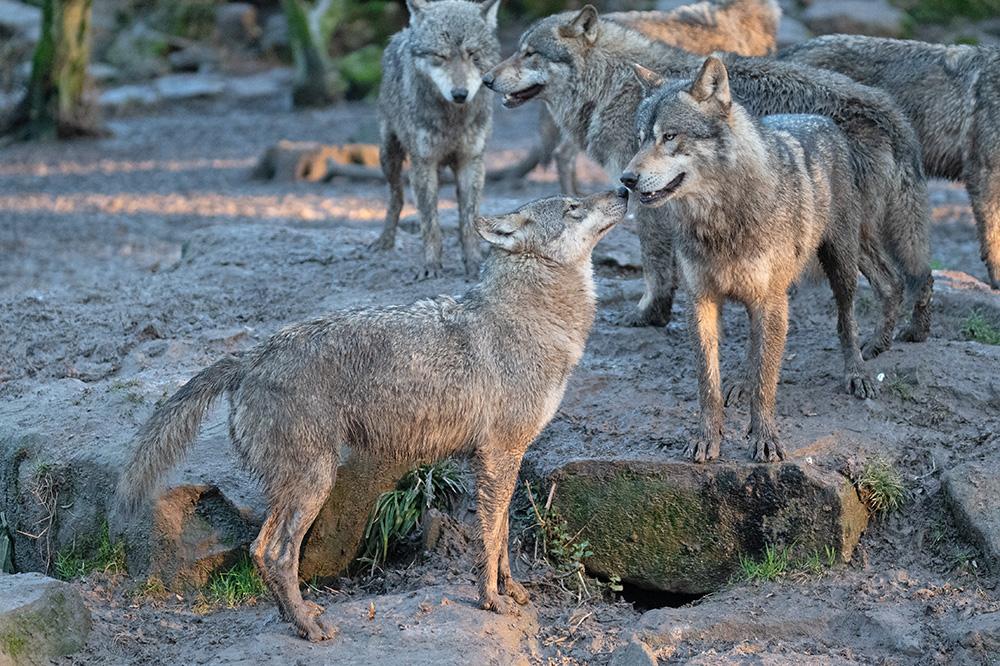
Indeed, the wolf is not merely a statistical unit marked as present or absent on a map. It is a social animal, typically part of a family structure, whose organization, movements, and use of the territory vary depending on the season, reproduction, the age of the individuals, the composition of the pack, and the disturbances the pack faces.
Understanding a situation before taking action therefore involves more than simply counting individuals.
A presence index tells only part of the story
Monitoring relies in particular on confirmed sightings, images, and videos obtained through camera traps, and genetic analyses. These tools are fundamental. But their value depends not only on their quantity and their distribution over time and space, but also—and above all—on how they are interpreted.
One or two DNA analyses can confirm that an individual has passed through an area. They are not necessarily sufficient to understand that individual’s role within the territory, its lineage, its social ties, its resident or transient status, or the family structure in which it lives. Genetics becomes much more informative when it is repeated, spatialized, and correlated with other identified individuals: parents, offspring, siblings, individuals from neighboring packs, or dispersing wolves.
This distinction is particularly important because it also makes it possible to track the movements of dispersing individuals and subadults from established packs, in order to better understand the species’ dynamics at the regional and national levels. When management measures are aimed specifically at reducing population sizes, the quality of genetic monitoring, knowledge of parentage, and data continuity become essential for understanding not only what is happening within the managed pack but also what happens afterward: the dispersal of individuals, the reconstitution of groups, the replacement of breeding individuals, or the establishment of new territories.
Publications from the canton of Graubünden, for example, illustrate a highly individualized use of this information. The reports do not merely confirm the presence of the species; they regularly discuss the genetic identity of individuals, their probable origin, their kinship with certain packs, and their potential establishment in new areas. In a 2024 report, the absence of genetic kinship between an identified female and the former Beverin pack is explicitly used to interpret the local situation.
This is not a matter of pitting cantons against one another but of raising a methodological question: to what extent should we rely on available information when it subsequently serves as the basis for a lethal intervention?
A social organization that evolves with the seasons
When discussing how a pack functions, the season is another fundamental factor that must be understood and taken into account in any decision.
Our image of a pack is often that of several wolves moving together within a territory. But in reality, packs are far from constantly moving together; this image corresponds much more to certain periods in winter than to the period when pups are being raised, namely between April and September.
The American scientific team from the “Voyageurs Wolf Project”—a University of Minnesota research program focused specifically on the summer ecology of wolves—clearly describes this change. After the pups are born in the spring, adults and subadults much more frequently become solitary hunters, traveling back and forth between their foraging areas and their dens or gathering sites.
A subadult photographed alone on several occasions, also during the summer, is therefore not automatically a solitary wolf in the biological sense of the term. It may still be a full member of its pack. A study by Scandinavian scientists observed that subadults gradually become more and more spatially independent, with a particularly marked separation occurring around the summer period.
This distinction seems simple. Yet it becomes crucial when an assessment seeks to determine the number of individuals in a pack, the possible presence of isolated individuals, or the distribution of several neighboring groups. An increase in individual movements is not sufficient to conclude that dispersal has occurred, that a lone wolf is present, or that a pack has broken up.
The composition of a pack therefore directly influences its spatial organization. And conversely, removing certain members can alter this organization. However, it is not possible to conclude that the presence of two wolves or a single individual on camera traps signifies the dissolution of the pack or the presence of individuals considered to be solitary.
Wolves also adapt their behavior to human pressure
Another factor must be included in the analysis: wolves do not move independently of what is happening around them. Several studies show that they adapt their schedules and their use of space in response to human disturbance (sources : 6-7-8). A European study based on camera traps deployed at nine sites between 2014 and 2022 showed that increased human activity was associated with an increase in nocturnal activity among wolves. When human pressure decreased, their diurnal activity increased.
Another study, based on 26 wolves fitted with GPS-GSM collars and more than 54,000 location records, highlights significant individual variability in response to human disturbance. Therefore, not all wolves react exactly the same way to the same disturbance.
In the Białowieża Forest, wolves tracked via GPS also demonstrated a preference for areas with higher levels of protection, as well as a modulated avoidance of roads and inhabited areas depending on the time of day and the level of risk. The authors interpret this behavior as a strategy to avoid human-related risk.
These results have a major methodological implication: a decrease in observations in a given area does not automatically mean an equivalent decrease in the number of wolves present. It may also result from changes in schedules, movement patterns, trail use, or resting areas.
Monitoring: Essential, but Not Sufficient on Its Own
Monitoring is the essential foundation for any understanding of a wolf population. Camera traps, genetic analyses, signs of presence, direct observations, and breeding monitoring make it possible to confirm the presence of individuals, document packs, and track their evolution.
But this data only becomes fully meaningful when placed in context. A photograph, a video clip, or a genetic sample establishes what was detected at a specific location and time. Taken in isolation, they do not always allow us to reconstruct how a pack functions, its family ties, its social organization, or the changes that have occurred over the preceding months and years.
This is why monitoring alone should not constitute a diagnosis. To move from detection to expert analysis, its results must be cross-referenced with all available field data: the pack’s history, genetics and lineage (when known), behavioral observations, reproduction, mortality, territory use, changes in the group’s composition, and interactions with neighboring packs.
In addition to this information, there is now another source of knowledge: the experience gained during previous control phases. After several years of interventions, certain situations have recurred, and their consequences can be tracked over time. The retention of a breeding individual, the arrival of a new individual, the persistence or dispersal of offspring, a new breeding event, or a change in territory use are all factors that can inform the analysis of a future situation.
The point is not to assume that one pack will necessarily evolve in the same way as another, but rather to avoid analyzing each situation as if it were the first of its kind. Monitoring establishes what has been detected, and the expert assessment—which must be conducted—consists of placing this data within a historical context, comparing it with scientific knowledge and experience gained in the field, and then examining the various hypotheses that the data allows us to consider.
If a pack alters its route by a few dozen or a few hundred meters, becomes more nocturnal, or uses its territory differently, the number of recorded sightings can vary significantly without a comparable change in pack size. It is also important to keep in mind that camera traps are not necessarily undetectable to wildlife. In the field, we observe that some wolves appear to detect them and may alter their path as they approach, bypass them, or avoid them. In a context of significant disturbance—particularly following intensive culling that has led to the loss of key individuals or a significant number of pack members—the hypothesis that wolves are bypassing certain devices cannot be ruled out, though it cannot be considered proven.
A decrease in photographic detections does not necessarily mean a decrease in the number of wolves and must be evaluated in light of other available evidence.
And above all: what can we learn from the culling operations already carried out in Valais?
This is probably the most important question. Since the start of proactive culling, several Valais packs have lost their breeding males. These interventions now provide some initial perspective, allowing us to observe not only the individuals culled but also what happened afterward within the family structures.
Summary Table – Sources: Mission Loup, GLS, KORA, and SCPF; C1* observations where indicated.
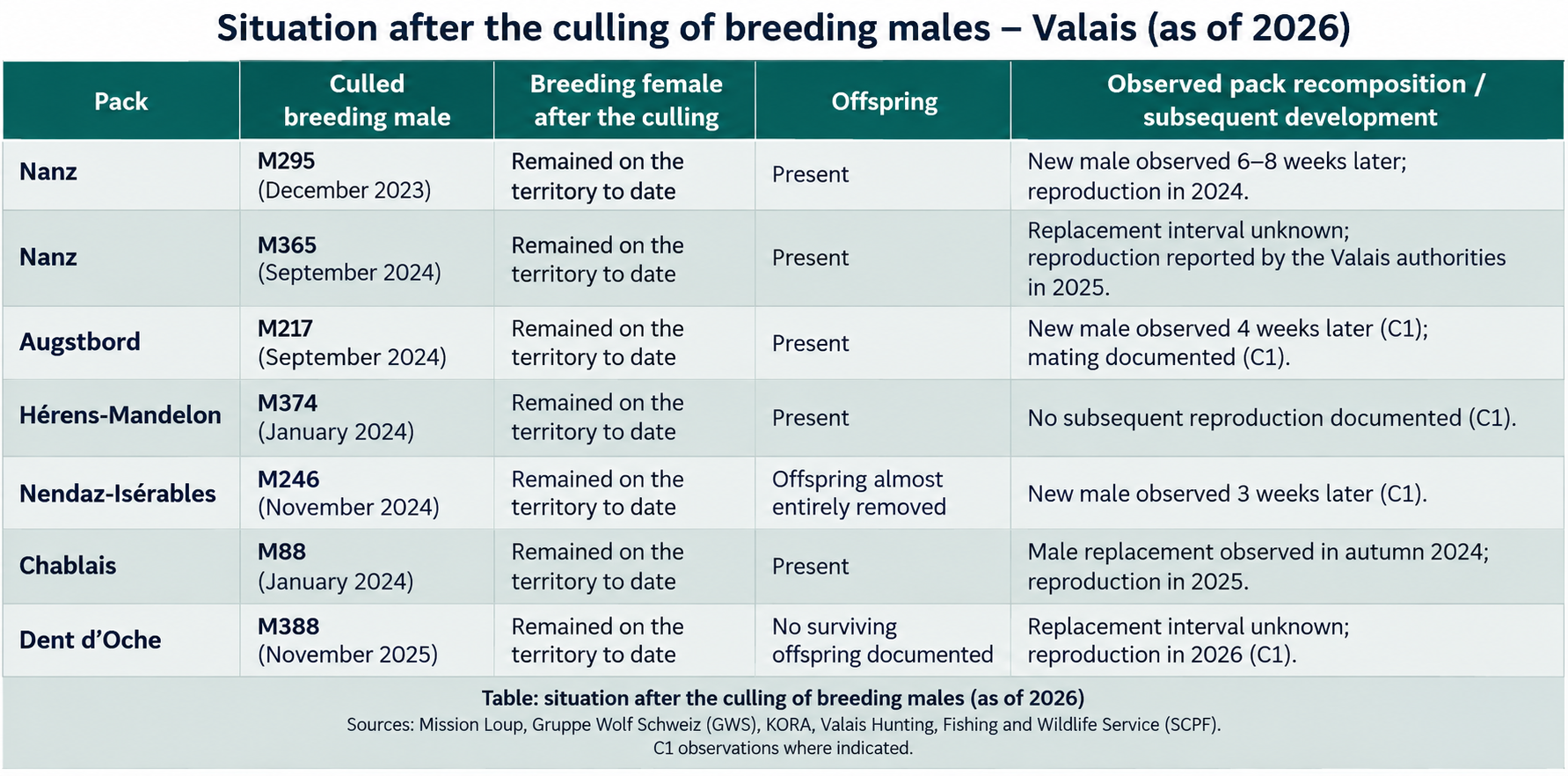 * C1 = data from certified evidence (video monitoring, genetic data, or sound level meter readings)
These seven cases, involving six packs, share a remarkable commonality: after the breeding male’s disappearance, the female remained in the territory in each documented case and is still there today. In several cases, some of the offspring also remained in the territory. When the arrival of a new male could be directly observed, it sometimes occurred very quickly, between three and eight weeks after the shooting.
Subsequent trajectories, however, are not uniform. Several packs experienced a new breeding cycle, while others, such as Hérens-Mandelon, followed a different path. The available data also do not allow us to determine whether the loss of the breeding male influences how long subadults remain with their mothers or their dispersal timeline.
These observations therefore do not allow us to establish a general rule. They do, however, constitute a valuable local historical record: they show which scenarios have already occurred in Valais, their potential recurrence, and enable us to formulate hypotheses that can then be compared with genetic and monitoring data, as well as with available scientific knowledge.
This is precisely one of the lessons that past management measures can teach us: an intervention does not merely result in a cull; it also generates data on its own consequences.
Local data do not replace science; they complement it
Studies conducted in Scandinavia, North America, Italy, Poland, or elsewhere are essential. They help identify possible mechanisms and shed light on behaviors already documented in the species in question. But no foreign study has exact knowledge of the Valais Alps.
The topography, human density, infrastructure, hunting, livestock farming, prey distribution, proximity of wolf packs, and intensity of culling create a unique context there. That is why the best approach is neither to ignore international publications in the name of local particularities nor to mechanically apply their conclusions to Valais. We must combine the two.
The scientific literature indicates what is biologically possible or probable. Local data make it possible to determine what has actually occurred here. When several years of culling experience already exist in a given area, this experience gradually becomes an indispensable source of information for subsequent decisions. It must therefore be taken into account in any future assessment, alongside data from field monitoring.
Before a new culling: a multi-level assessment
A robust assessment could thus systematically be based on several complementary levels. First, establish the facts: minimum number of confirmed individuals, reproduction, predation, mortality, C1 indices, and protective measures. Next, reconstruct the family structure as much as possible using sufficiently abundant, mapped, and distributed genetic data: identities, sex, parentage, origins, and movements between packs.
Then analyze spatial and temporal dynamics: camera traps, location of evidence, season, movements of subadults, encounter zones, and any changes in territory use. These observations should also be contextualized within the known biological behavior of wolves: summer and winter organization, cooperative rearing of pups, dispersal, behavioral plasticity, and documented responses to human disturbance.
Finally—and this point is now essential in Valais—each new situation should be evaluated in light of the consequences observed during previous culls. In the case of decisions concerning individuals believed to be solitary and located within the territory of packs that have undergone partial culling, the essential question to ask is the following:
What happened after the culling of breeding males, of which seven cases have already been documented and are available?
It is precisely this final step that could transform several years of culling into genuine knowledge. It would broaden the scope of expertise by taking into account the wolf’s biological functioning, its possible responses to human disturbances, and the insights gained from previous interventions, while maintaining a principle of caution when data—particularly genetic data—remain insufficient.
Culling should not be evaluated solely based on the number of wolves killed, as reported to the public and the media. This figure provides information on the scale of the interventions carried out, but not on their effects. Each phase of population control should also provide a better understanding of its consequences on pack dynamics, their social organization, and their use of the territory, as well as assess whether the interventions have actually produced the desired effects on predation of livestock. This can be achieved by providing figures on losses in protected areas at the local level—that is, within the territory of the regulated packs—from one year to the next.
In other words, the number of wolves culled measures an action. It does not measure the result.
The Salentin Pack: Why Context Matters as Much as Detection
Without making all the data public at this stage that would allow for a detailed analysis of this pack, its evolution and recent decisions raise a methodological question.
When a situation becomes unusual or difficult to interpret, should we base our reasoning primarily on the number of individuals detected at a given moment? Or should we first reconstruct its history: previous mortalities, the possible disappearance of a breeder and its consequences for the pack’s organization (analysis of precedents), the kinship of the detected individuals, the biological season, the movements of subadults, relationships with neighboring territories, changes in camera trap records, and precedents observed elsewhere in the canton? The difference is considerable. In the first case, we capture a snapshot of a situation. In the second, one seeks to understand the process that produced it.
The recent case of the Salentin pack illustrates the importance of this cross-analysis of data. Indeed, based on the already documented consequences of proactive population control, after three years, it is evident that the death of a breeding male has never led to the breeding female leaving the territory; she has always remained there. This precedent obviously does not allow us to affirm its presence in a new situation, but it constitutes a biological hypothesis that is sufficiently plausible to warrant investigation, comparison with available data, and consideration in any future culling efforts.
The absence of detection is therefore not necessarily proof of absence, particularly in a species whose movements, group cohesion, and territory use vary depending on the season and disturbances. This is precisely the difference between noting what monitoring detects and assessing what the data as a whole suggest.
Regulation itself should become a subject of monitoring
Since 2023, Switzerland has no longer been merely conducting wolf monitoring. It is, in fact, carrying out a large-scale management experiment. Each intervention generates data: the reactions of survivors, the maintenance or disappearance of family structures, the recruitment of new individuals, changes in damage, territorial movements, and new litters.
Failing to systematically analyze these consequences would amount to losing a considerable portion of the knowledge generated by the interventions themselves. The objective should therefore not be to demonstrate whether regulation works or does not work. It should be much simpler: to determine in which situations it achieves the desired objective, in which situations it does not, and which parameters help explain this difference.
And this is precisely what the scientific approach allows us to do: evaluate results, test hypotheses against data, and adapt decisions accordingly. The decision may be political; its basis and the assessment of its effects must remain scientific.
Understanding to Make Better Decisions
After several years of regulation, Switzerland now has the benefit of hindsight, which should become a source of knowledge. Every intervention, every change to a pack, and every shift in predation patterns provides data that allows us to assess the actual effects of the decisions made.
Analyzing this data does not mean either defending or condemning population control. It means seeking to understand when it achieves its objective, when it does not, and why. Because intervening in a pack is not merely a matter of adjusting its size. It involves intervening in a family structure, a territory, and constantly evolving dynamics. As for the culling of individuals believed to be solitary, within the territory of packs that were previously regulated but have not disappeared, it is important to note that taking into account all the data collected, the available scientific knowledge, and the now-documented precedents appears essential for a sufficiently robust assessment.
The question, therefore, may no longer be simply how many wolves live in a territory, but how far we are willing to go to understand the consequences of our own decisions there. Counting helps us understand a population; understanding helps us manage it better.
Article: Team Mission Loup
Photo: Groupe Loup Suisse (Augstbord) & Mission Loup
SOURCES
wolf pack nature wildlife project study shooting regulation loup nature faune sauvage meute forêt étude régulation prédation comportement
Related posts
