
DISCOVER WOLF MISSION
WOLF MISSION
Since 2022, Mission Loup has sought to better understand wolves, wildlife, and the interactions that shape our lands.
Throughout this page, we invite you to discover the story behind this project, the values that drive us, our approach to our work, and the men and women who, every day, work in the field to better understand wildlife, wolves, and wolf packs in French-speaking Switzerland.
And if this adventure resonates with your own values, perhaps you’d like to help us write the next chapter, in various forms? Feel free to reach out to us using the contact form at the bottom of the page!
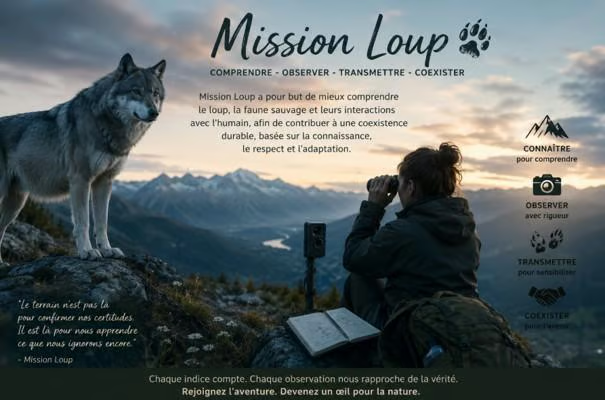
“The field isn't there to confirm what we already know. It's there to teach us what we don't yet know...”
A PACK, A STORY, A PROJECT...
In 2021, a wolf pack settled permanently in the Val d’Hérens, in the heart of the Wallis/Valais Alps. Like many others, it quickly sparked questions, concerns, fascination, and debate. For most people, this pack was then nothing more than a name on a map or a news story. But for us, it became an opportunity to learn.
Through our monitoring, we’re gradually discovering the richness and complexity of how the pack functions: its social organization, its use of the territory, its interactions with wildlife, neighboring packs, the pastoral community, and human activities. As the months go by, one thing becomes clear: understanding a pack isn’t just about observing wolves. It’s about learning to read a living, constantly evolving territory.
That is how the Wolf Mission project was born!
Since 2022, our team has been monitoring this pack—which we call “Arsene’s pack,” in reference to its alpha male, whom we had to give a pseudonym simply to avoid revealing the identity of the pack we’re studying—in order to better understand its dynamics, its evolution, and the many factors that influence its daily life. Our knowledge of the region, gained over several years, has allowed us to understand a number of extremely important points; this has been an invaluable and essential aid.
The years that followed brought many changes to the pack. Regulations, poaching, the loss of several members, social reorganization, the dispersal of young wolves, and the emergence of new packs descended from its lineage... Its story has come to reflect not only the challenges facing large predators today, but also the territories they share with humans.
This monitoring effort is now at the heart of Wolf Mission. It informs our research, our outreach efforts, our training programs, and our reflections on the coexistence between humans and wildlife.
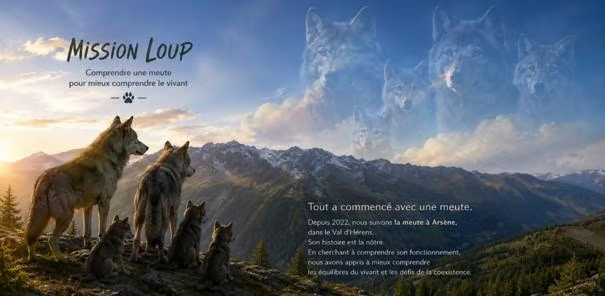
“It all started with a pack. Since 2022, we have been monitoring the pack in Arsène, in Valais.
As we sought to understand how it functions, we gained a deeper understanding of the balances of life and the challenges of coexistence.”
OUR MISSION & OUR GOALS
The goal of Wolf Mission is to improve our understanding of the wolf packs in Wallis/Valais, their social dynamics, their use of the territory, and their interactions with wildlife, the pastoral community, and human activities. This knowledge serves as a tool that makes it possible to:
* better anticipate challenges.
* identify high-risk situations.
* improve our understanding of how a wolf pack functions in a given location and environment over a specific period.
* provide data and insights into the changes caused by various internal and external factors.
* facilitate the establishment of a more sustainable coexistence in the future.
Ethics is our guiding principle, whether in wolf and wildlife management or in the decisions made by any higher authority.
“We're not out in the field to defend a preconceived idea. We're out in the field to learn, to observe, and to understand.”
For Wolf Mission, one of the most important qualities in the field is the ability to observe without immediately seeking an explanation, much less a conclusion. A single clue never tells the whole story. A footprint, a carcass, droppings, or a photograph only make sense when placed in context and when a situation is assessed in its entirety, using all available data.
The role of each member of our team is therefore to document before explaining.
Wolf Mission seeks not only to generate knowledge—important as it is—but also, and above all, to share it, to the extent possible. We always keep in mind the pressures on the packs, and we have also chosen not to disclose certain information in order to ensure the safety of the wolf packs in Wallis/Valais.
Through our website, our Instagram page, as well as lectures, school presentations, field courses, publications, and dialogue with political and pastoral leaders, we aim to make this knowledge accessible to as many people as possible. Understanding is the first step; sharing is the second.
OUR VALUES
A PHILOSOPHY BEFORE A METHOD
Protocols evolve, knowledge advances, and sometimes tools change, but our values remain the same. They form the foundation upon which each of our actions rests. We want to understand; we reject hasty conclusions because every situation has its own context, every territory is different, and every pack is unique. It is important to recognize that living organisms are constantly evolving; therefore, assessments made today will likely no longer be valid in 3 days, 3 weeks, or 3 months. This is an inescapable reality: any change, no matter how slight, can alter a behavior, a situation, or an environment, thereby requiring adjustments over time.
“The field does not seek to confirm our certainties. It invites us to deconstruct them.”
We know full well that working with living beings means learning to deconstruct our certainties, because nature will never cease to surprise us. It challenges our assumptions. It compels us to remain curious, committed, engaged, and attentive, constantly analyzing and researching. We view this constant questioning as a strength; it is what allows us to move forward, step by step.
RESPECT FOR WILDLIFE
Respect does not apply solely to wolves; it extends to every living being. We are aware that every species plays a role, that every territory has its own balance, and that we are merely guests in nature—a world we must respect.
Observation therefore involves minimizing our impact as much as possible, avoiding disturbances, respecting the needs of each species, and being as discreet and unobtrusive as possible. Monitoring, which involves setting up camera traps, is organized very strictly in advance to avoid entering areas or during periods considered sensitive (rendezvous sites). We never approach dens or rendezvous sites, in order to avoid any disturbance or stress, as the packs are already disturbed enough by human activities, particularly culling. We do not use any methods (such as howling, etc.) that could compromise the pack’s safety, as the pack’s safety is our top priority.
COEXISTENCE
For Wolf Mission, coexistence does not mean the absence of conflict, which is naturally and humanly impossible. It means learning to live with a reality that we cannot fully or always control. This sometimes involves adjustments within the pastoral community, centered on protection and the commitment it requires. At other times, it involves management decisions when certain situations become problematic.
It is important that every decision always be based on a thorough understanding of the facts and their consequences. It is vital that these decisions not stem from personal opinions, superficial assessments, or external pressures, but solely from meticulous analyses of the data collected on the packs and the overall situation. We emphasize that it is also essential not only to consider the short-term implications but to look well beyond them, into the coming years.
Coexistence is based on understanding, anticipation, adaptation, and the constant search for solutions.
SCIENTIFIC HUMILITY
Scientific knowledge is indispensable when dealing with living organisms, whether in the natural sciences, medicine, or any other field. But it is never a fixed truth; it is a reality to be understood and integrated. Fieldwork continues to enrich our understanding over the course of months and years, through discoveries and changes resulting from population regulation, births, mortality, and everything that occurs within a pack’s territory.
“We're not out in the field to defend a preconceived idea. We're out in the field to learn.”
We therefore constantly seek to compare our observations with existing knowledge through observation, comparisons (when possible and scientifically valid), in-depth reflection, learning, evaluations, and so on. And we systematically start over with every step we take, every change, and every discovery.
PEOPLE BEFORE OPINIONS
Wolf Mission brings together people with very different backgrounds, perspectives, and experiences. We firmly believe that dialogue is always more fruitful than confrontation. Understanding a farmer’s concerns, listening to a naturalist’s observations, exchanging ideas with a photographer, or talking with a local resident is an integral part of our approach. Every encounter, every conversation, is an opportunity to learn and to better understand all the facets of this issue—from fear to anger, from admiration to acceptance, from the workload to the need for support.
OUR COMMITMENT
Like any other organization or entity, Wolf Mission does not claim to have all the answers. Living beings hold secrets and play roles that, to this day, have not been fully discovered or necessarily studied. We therefore do not have a complete understanding of how wolves function, but only of what they allow us to discover over time through in-depth work, as circumstances change.
We are simply committed to continuing to search, to observe with honesty, to communicate with rigor, and to systematically question our assumptions. We are also committed to doing everything in our power to better understand living organisms, including the wolf, and to contribute, in our own small way, to a more sustainable coexistence between humans, wildlife, and the territories they share.
ABOUT US...
Wolf Mission did not begin with the intention of creating an organization. It began with a question:
How can we better understand wolves in Switzerland, right here at home?
Behind every sighting, every piece of data collected, every conference, every school presentation, and every day in the field are men and women who devote their time—including time from their personal lives—to better understanding the natural world. Our team brings together a wide variety of professionals: biologists, ethologists, zoologists, naturalists, veterinarians, educators, specialists, wildlife lovers, hunters, and more. In Wallis, in Switzerland but as well as in neighboring countries, thanks to our WOLVES WITHOUT BORDERS NETWORK.
Wolf Mission believes that diversity of skills is a strength. Each person contributes their perspective, experience, observations, questions, and expertise. Some excel at field observation, while others excel at data analysis, photography, education, communication, or organization. By allowing everyone to contribute in the areas where they are most competent and fulfilled, we build a team that is not only more effective but also more human. It is this diversity that makes Wolf Mission so rich today.
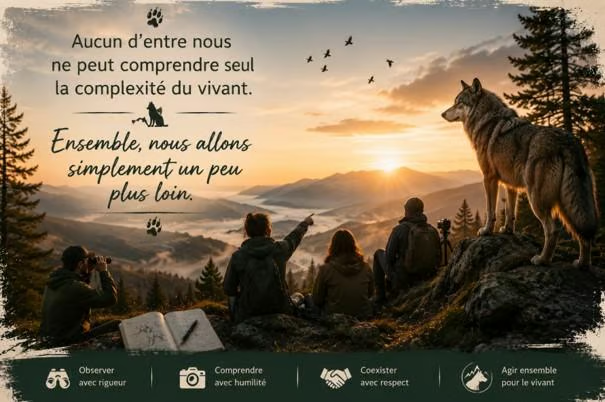
"None of us can fully understand the complexity of life on our own.
But together, we can go a little further."
OUR PROJECT MANAGERS
ISABELLE
Director for the French-speaking region of the GROUPE LOUP SUISSE association (in place since 1998), where she has worked for nearly 10 years, Isabelle has always been deeply passionate about nature and wildlife. Even as a child, she would spend hours with a pair of binoculars in hand, exploring valleys in search of wildlife. An avid reader of books and academic studies in four languages, a seasoned self-taught scholar with a keen interest in science, wildlife, analysis and genetics, she also he has federal certification in the care of canids, felids, rodents, and reptiles. Dynamic and highly creative, she has already launched three projects focused on wolves (support for pastoral work, wolf research, educational program), always driven by her desire to learn, understand and help—her three main motivations. She conceived & designed Wolf Mission following a difficult period, and today it has become both its heart and its backbone. She is always available to answer questions from the press, volunteers, and the public, guided by the ethics, neutrality, and values that are an integral part of who she is.
VIRGINIE

A biologist with a master’s degree in ecophysiology and ethology from the University of Strasbourg (France), Virginie has spent a great deal of time studying primates and working with them, particularly in South Africa. Driven by a deep passion for the natural world—a passion she shares with her two colleagues—she is constantly striving to understand, learn, and unravel mysteries through in-depth studies and meticulous observations. She also aims to raise awareness and impart to younger generations, as well as the general public, a better understanding of animal behavior, particularly that of wolves. Her infectious passion and educational approach make her a true ambassador of knowledge, capable of raising awareness and inspiring wonder at the richness of the animal world. She is an extremely valuable asset in behavioral analysis, which is essential for better understanding how wolves and wolf packs function, as well as the factors surrounding them. She has already participated in several TV shows and public appearances as part of the Mission Loup project, although she prefers working directly with wildlife, deep in a valley or forest. There, she devotes herself to observing every species, every connection, every clue...
SONNY
Zoologist, with a degree in wildlife conservation from the University of Southampton (England), Sonny wrote his thesis on the reintroduction of wolves in Scotland and also participated in a project to census wolves, bears, and lynx in the Velka Fatra Mountains in Slovakia. Currently, he also serves as co-director, alongside Isabelle, of the EDUWOLF educational program, which has a huge success with schools and youth groups in French-speaking Switzerland. His role as a cultural mediator, his passion, his natural talent for communication, and his in-depth knowledge of living organisms and wildlife allow him to captivate his audience through a lively, educational approach that blends humor, rapport, and expertise. He recently completed a course at the University of Oxford on data analysis and statistical methods for field ecologists and biologists. Sonny is highly dedicated and committed; like his two colleagues, he has a thirst for in-depth, general knowledge, values impartiality, and devotes all his talents to supporting the Mission Loup project and the wolf packs of Valais.
Every observation brings us closer to a better understanding of life. And every person who joins this adventure contributes, in their own way, to writing the next chapter of this story. If this project resonates with your values, if you’d like to get involved with us, share your skills, or explore a collaboration, we’d be happy to talk with you. Please contact us using the form below.
“One team, one network, a shared passion: understanding to live together better.”

Last edited: 28/07/2026