

PART 2 - Wolf regulation, a scientific study...under institutional influence?
Continuation and conclusion of our article, in which we address the concrete problems that could compromise any rigorous scientific analysis.
When data, practices, and institutional frameworks cloud scientific assessment
In the first part, we showed why assessing the effectiveness of proactive wolf regulation is inherently complex. In this second part, we address the concrete problems that may compromise any rigorous scientific analysis: data quality, heterogeneity of practices, and risks of institutional bias.
1. Protective measures: between identified measures and effective implementation
The effectiveness or otherwise of regulation cannot be assessed without precise knowledge of the actual state of herd protection at the time of attacks. However, in the field, there is a significant discrepancy between administrative records and the reality observed.
It is not uncommon to find:
- non-compliant fences (insufficient height, wires too far apart, no or partial electrification).
- fences that are damaged or broken in certain sections.
- temporary or modified systems during the season without updating the records.
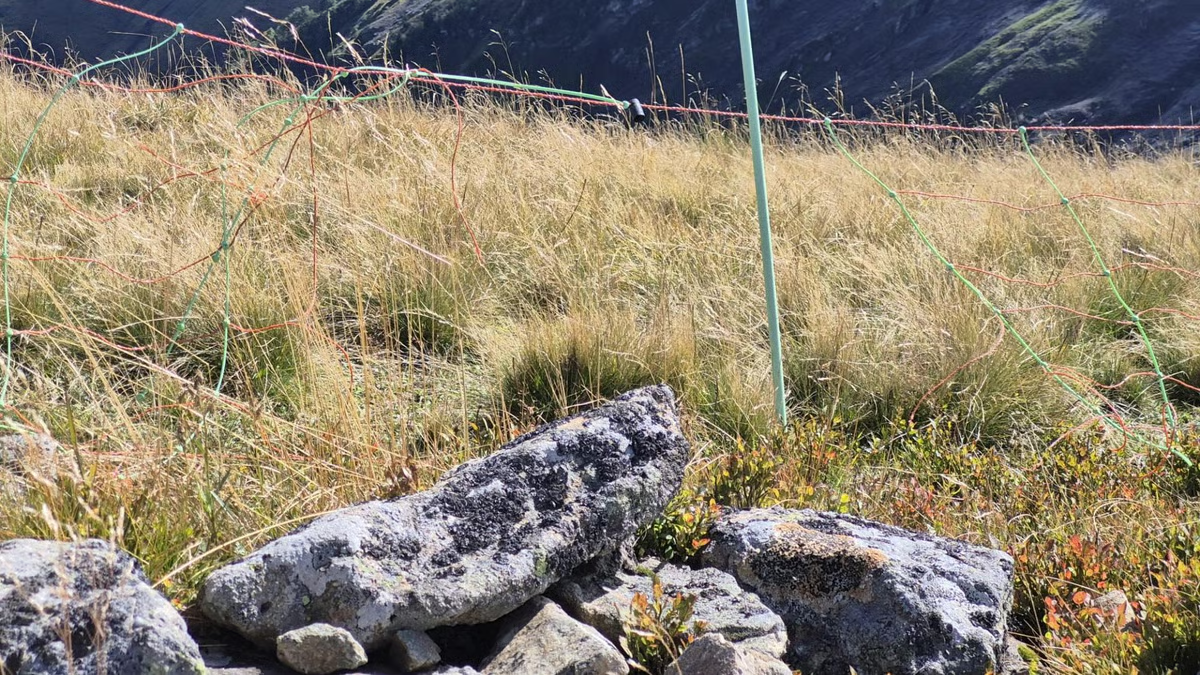
Photo: Wolf Mission - Condition of a fence protecting a herd that has suffered several attacks in a protected area, leading to the designation of the pack for total culling in 2025/2026
Several factors directly influence the effectiveness of guard dogs:
- their actual ability to protect (certified ancestry, training of the people who raised them, behavior towards wolves, etc.).
- their physical and mental health.
- their continuous presence with the herd.
- temporary withdrawals (illness, heat, conflicts, fatigue).
These parameters, as well as any withdrawals, sometimes of short duration, are not systematically included in the reports, even though they may coincide with attacks and greatly influence the state of protection.
Finally, changes in shepherds, practices, or the organization of summer grazing from one year to the next profoundly alter the dynamics of protection. However, these changes are rarely taken into account in detail in the analyses, as the factors are not necessarily known or listed accurately in the files.
Scientifically, this poses a major problem: if the evolution of protection is not precisely known, it becomes impossible to attribute a variation in attacks to regulation rather than to a change in practices. This study must therefore demonstrate with complete transparency that all of this data is known and has been clearly taken into account, with supporting documents available for consultation. It should be noted that precise data on protection measures for each region and mountain pasture is not published anywhere and is extremely difficult, if not impossible, to obtain from government agencies.
2️. The wolf factor: incomplete data and partial understanding of packs
The assessment of regulation is also based on a detailed knowledge of how packs function. However, in some cantons—particularly in Valais— direct field monitoring is carried out by wildlife rangers (state service), with the data then being collected by KORA.
The analyses are therefore based, for the most part, only on cantonal data and their interpretation.
The reports compiled for five packs involved in proactive regulation between late 2023 and early 2025 highlight:
- serious inconsistencies and errors in the establishment of territories.
- approximations in the composition of packs.
- lack of knowledge and failure to take into account buffer zonesinconsistencies and errors in the establishment of territories.
- and uncorrected shortcomings from one year to the next.
These errors have direct consequences:
on the understanding of the role of the individuals killed.
on the establishment of shooting perimeters, leading to shooting errors.
on the interpretation of the effects of shooting.
and on the analysis of territorial dynamics.
In some cases, the biological parameters that are decisive for local assessment (stability of the breeding pair, actual presence of pups, dynamics with neighboring packs, actual territory, presence of buffer zones) appear to be insufficiently documented or subject to uncertainty. However, requests for regulation of entire packs have been validated and granted, leading to a number of errors in more than one regulatory phase.
It should be remembered that the reliability of a scientific analysis depends directly on the accuracy and traceability of the basic data. When field data collection and scientific assessment are not clearly articulated or independently verifiable, the robustness of the conclusions may be compromised.
3️. How regulation works: lack of comparison and heterogeneity of methods
The most problematic point for scientific evaluation lies in the way proactive regulation has been implemented.
a) Lack of a test phase and comparison groups
Regulation was applied quickly and simultaneously in several cantons, without:
- a pilot phase.
- control areas.
- targeted selection of only the truly problematic packs.
Some stable packs, which did not exhibit any significant problematic behavior towards livestock, were regulated, often partially but with the loss of members of breeding pairs, which seriously disrupted them on several levels.
This approach prevents any reliable comparison between:
regulated and unregulated packs.
different methods, which varied from one phase to another.
periods before and after intervention under similar conditions.
b) Diversification of methodologies
Each canton was able to choose its own strategy:
- Elimination of a targeted individual.
- Slaughter of two-thirds of the pups.
- Complete elimination of packs.
These methods varied:
between cantons
from one year to the next
sometimes even within the same canton.
In some cases, individuals outside the targeted packs were killed, further complicating the interpretation of the effects, especially when the basic data was already flawed.
Scientifically speaking, these disparities, along with the lack of nuance and, above all, the absence of an experimental design upstream, will prevent any conclusions from being drawn. It will be possible to establish correlations, but not to provide clear answers regarding cause and effect! Switzerland has therefore clearly missed a great opportunity to demonstrate the benefits of regulation compared to other environmental co-factors, particularly herd protection measures!
4. Cross-border packs: a worrying blind spot
The assessment is even more fragile for cross-border packs, particularly with France.
Since 2023, wolf monitoring in Haute-Savoie is no longer carried out by the French Office for Biodiversity (OFB), but has been entrusted to local hunters. After a very short period, this monitoring has deteriorated significantly and is believed to have ceased altogether to date. No scientific monitoring has therefore taken place in France since the start of proactive regulation in Switzerland (2023), which is a worrying fact.
The consequences are significant:
- incomplete data.
- partial knowledge of actual population numbers.
- limited understanding of territorial dynamics.
- lack of a coordinated view of the effects of shooting on both sides of the border.
Some packs showing repeated signs of presence and reproduction do not appear to be systematically recognized as coherent functional units in Swiss records. The situation of the Chablais, Dent d'Oche, and Hauts-Forts packs illustrates the complexity of cross-border dynamics between Switzerland (Valais) and France.
The inclusion of this data in the Swiss assessment does not always appear to be explicitly reflected in the cantonal records available for consultation. In the context of cross-border populations, however, structured coordination and systematic exchange of information between national authorities are crucial for a comprehensive assessment of pack dynamics and their conservation status.
Under these circumstances, any scientific analysis of the effects of regulation on these packs is necessarily incomplete.
5. Scientific independence and institutional framework
Finally, there is the question of the independence of the announced study. The DETEC (Department of the Environment, Transport, Energy and Communication) and the FOEN (Federal Office for the Environment, part of the DETEC) finance KORA and at the same time implement federal policy facilitating the shooting of wolves through intensive and proactive wolf control. One of the stated objectives of this federal policy is precisely to facilitate the shooting of wolves through intensive and proactive regulation of wolf packs, which, according to the policy, will reduce predation and also have an educational effect on wolves.
This institutional configuration raises a question of functional separation: the study is being conducted by KORA, an organization funded by the public body responsible for implementing the regulatory measures that are precisely the subject of the evaluation. Such an arrangement calls for explicit clarification of the guarantees of scientific independence and external control mechanisms.
In terms of institutional influence, there are unfortunately precedents, notably with changes to words, sentences, or figures in national reports, such as the one on biodiversity in Switzerland or during the motorway initiative. Another highly contentious and unethical case occurred in Valais during the 2024/2025 proactive regulation phase. The regulation requests for two packs, Hérens-Mandelon & Les Toules, were rejected by the Federal Office for the Environment (FOEN) as they did not meet the required conditions. The FOEN then set out clear requirements for the canton, namely proof of reproduction (with only pups being shot) for the first pack and an additional attack for the second (which had only committed one attack in a protected situation - 1 sheep killed -, thus not fulfilling the requirements of Article 4b36 - 4b of the law). All it took was an informal visit by Valais State Councilor Frédéric Favre to Federal Councilor Albert Rösti and FOEN Director Katrin Schneeberger for the Valais politician to come away with both shooting permits...without the previously set requirements having been met!
In this context, complete transparency regarding the data, methods used, and limitations of the study will be essential to maintain its credibility. Access to the documents comprising the study will also be essential.
6. Conclusion
The issue is not to deny the difficulties encountered by the pastoral world, nor to reject any form of wolf management. The question is whether Switzerland is really giving itself the means to rigorously and independently evaluate the effects of such a far-reaching regulation.
As things stand at present:
The data is sometimes incomplete or inaccurate.
Practices are too heterogeneous.
Comparisons are insufficient.
The risks of institutional bias are very real and significant.
Without a major effort to ensure transparency, correct the data, and integrate all available knowledge, the announced study is more likely to justify a policy after the fact than to shed objective light on its effects.
We will have to wait until 2029 for the results. And, until then, observation, vigilance, and independent documentation, through field monitoring, studies, and in-depth analyses, remain essential.
We would like to thank everyone who, through their field reports and vigilance, has contributed to developing a comprehensive and well-documented overview of the situation of wolf packs in Valais. This mobilization demonstrates the sustained attention paid by civil society to the management of the wolf, of wildlife, and the importance attached to transparency in public decision-making.
Article: Team Mission Loup
Photo: Illustrations & Mission Loup
régulation wildlife pack nature wolf prédation faune sauvage meute étude nature loup shooting regulation project study
Related posts

From Monitoring to Expertise—Understand Before Regulating
We explain why counting, photographing, and identifying wolves isn’t always enough to understand how a pack functions. We discuss the various factors that can skew our understanding and, as a result, lead to decisions that aren’t necessarily suited to the reality on the ground.