

The “always more” trap in wolf management
Today, we’re addressing a topic that’s unavoidable these days. Since the introduction of proactive regulation in September 2023, political motions have come one after another at a breakneck pace, demanding ever more: the ability to regulate wolves in hunting reserves, but also year-round (including during sensitive breeding periods), or even to set hunting quotas once the wolf population reaches certain levels (to be determined).
We had already announced and explained this: the implementation of a more intensive form of regulation, such as that practiced since 2023, systematically opens the proverbial Pandora’s box. Without a thorough and independent scientific assessment to clearly measure the medium- and long-term effects of this strategy (see our article PART 1 - Wolf regulation - a scientific study...under institutional influence?), it will be extremely difficult to achieve the goals set by the groups advocating for it. And this is even more true regarding certain specific objectives, which we will detail below!
A LOOK BACK AT THE SITUATION IN SWITZERLAND
To gain the broadest possible view of the situation and its evolution, it is necessary to look back:
YEAR 2017
2 packs present in Switzerland (1 purely Swiss pack and 1 cross-border pack—2 packs having been disbanded during the year).
Between 40 and 50 wolves detected.
288 livestock animals killed by wolves across the entire Swiss territory, across all protection categories (442 in 2016, 525 in 2018).
Even at that time, through press releases and articles from the farming community and certain politicians, the situation was already highly intolerable and unacceptable; swift ACTION was needed. Significant pressure was then placed on the federal government, among others, to demand more comprehensive and drastic wolf management measures. This pressure led, in 2019, to a revision of the Hunting Act (LChP), which was subsequently rejected by the public in a referendum (2020).
With the introduction of proactive regulation in September 2023, Federal Councilor Albert Rösti established a minimum number of packs in Switzerland, distributed across five regions. The choice of this threshold of 12 packs continues to be debated, particularly due to the existing differences between political approaches and previous scientific assessments. But let’s start with Mr. Rösti’s intentions to outline the situation as it could be with the pre-established quotas:
YEAR 2020
10 packs on Swiss soil.
Approximately 140–150 wolves present.
917 livestock losses, across all protection categories.
It should be noted that the annual loss totals provided by the Federal Office of the Environment/KORA include all animals killed, whether protected, unprotected, or located on pastures that cannot be protected (areas where it is impossible to implement official protection measures). This generalization—even though only losses in protected situations are taken into account for the so-called proactive management—is problematic, lacking in precision and transparency. It also has a significant influence on public opinion, which may lead people to believe that the pastoral community is being harassed despite protective measures.
To help the public better understand, we clarify that the “unprotected” situation encompasses two categories: animals not inside night pens/structures at the time of the attack (not brought in) or the voluntary absence of official protection despite the area being deemed protectable (at the farmer’s discretion).
With regard to the year 2020, we therefore cite the example of the two cantons that suffer the most attacks each year. In Valais, 88% of the 302 livestock animals killed by wolves were in unprotected or unprotectable situations. That is, only 26 were properly protected. In Graubünden, the exact number of attacks in protected situations was not publicly disclosed, but of the 248 animals killed throughout 2020, the authorities’ report states that “some attacks occurred despite the official herd protection measures that had been put in place.”
Of the total 917 losses, there would therefore have been no more than 150 to 350 animals killed in protected situations across all of Switzerland! As a reminder, that year, 167,393 sheep were put out to pasture; the percentage of sheep killed that were protected by at least one of the protective measures would therefore be 0.2%!
It is clear that no organization, whether political or scientific, will ever be able to make predictions regarding annual predation. The factors influencing it are numerous, logically fluctuating, and must therefore be analyzed holistically. Regulation is just one among many; it is necessary to be fully aware of this. However, based on the situation in Switzerland since 2019, we must assume that with a minimal number of wolf packs—in line with the political wishes of the SVP Federal Councilor—annual losses to livestock herds would range between 700 and 1'100 animals, regardless of the specific protection measures in place.
PROTECTION: DEMANDING THE IMPOSSIBLE WHILE UNDERMINING THE ESSENTIAL
However, it is important to note that any form of regulation must absolutely take into account the so-called viability threshold, in order to ensure the protection and health of all species, whether protected or not. This must be done at both the regional and federal levels, as clearly required by the Bern Convention. Given the figures provided, the workings of living organisms and nature, as well as the relative effects of regulation—not to mention its costs—there is one element that must be clearly understood and taken into account:
NO PROTECTION MEASURE WILL EVER BE FAIL-SAFE!
It quickly becomes clear that the latest motion, introduced by PLR politician Alex Farinelli, will not resolve any of the issues surrounding this topic, since we will also have to contend with healthy regional wolf populations. And when you consider that a single wolf can kill more livestock in just a few days than the stable packs targeted for culling do in an entire year, it’s easy to see why.
Added to this is an issue that is rarely discussed but nonetheless central: the gradual weakening of the guard dog system, despite its reputation as one of the most effective means of limiting predation. The reorganization of the federal program in 2025 appears to have revealed several areas of uncertainty, particularly regarding legal protection, the regulation of breeding and selection, and above all the training of dogs during their first months of life—a period that is nonetheless decisive and crucial for their behavioral development and future skills.
However, protective abilities rely on complex balances: genetic selection, socialization, field experience, and the quality of training. A weakening of these elements could lead to two problematic outcomes: dogs insufficiently capable of protection, or, conversely, dogs poorly prepared for interactions with mountain users.
Given the high volume of tourists during the summer season, this issue deserves special attention. Coexistence depends not only on wolf population management, but above all on maintaining effective, stable, and properly supervised protection measures. We reiterate: protection is the essential element for preventing predation, a fact recognized even by the Federal Office for the Environment.
It is, however, interesting to note that none of the politicians submitting all these hunting motions are offering equivalent reflections on the development of protection measures, the improvement of tools, or a potential weakening of these measures, nor are they pressing the issue with higher authorities—which is also significant in terms of their intentions and objectives...
SUCCESS OF PROACTIVE REGULATION?
Although this is not the subject of this article, we would still like to mention the latest press release from the Federal Office for the Environment (FOEN – May 2026) regarding the “results” of proactive regulation. Although the press release claims a certain degree of success for proactive regulation in curbing the wolf population and emphasizes the protection of herds and its effectiveness, it remains very “superficial.” In fact, it is based on aggregate figures and assessments, whereas it would be necessary to examine the situation at the cantonal and, above all, regional levels—specifically within the territories of the targeted packs (has there been a real reduction in pressure and attacks?). As a reminder, only an in-depth study, free of institutional bias and taking all factors into account, could potentially provide a more thorough understanding of the actual effects of the culling.
The press release also mentions “exponential growth.” However, the use of this term is debatable given current knowledge of the population dynamics of large predators, which are generally subject to natural mechanisms of territorial and demographic stabilization. Furthermore, there is no mention whatsoever of the consequences for wolves or packs, nor of the observed abuses, with errors being carefully glossed over or downplayed.
We would like to point out that the cantons of Graubünden and Valais already have a very large wolf population and a significant number of packs. The territories are therefore naturally and gradually reaching saturation, which in turn leads to a stabilization of pack and wolf numbers. Other existing factors must therefore be taken into account and mentioned in order to attempt to explain the slight stagnation of the wolf population.
And has the population really been curbed? According to the official KORA graph below, there were 8 additional packs between 2022 and 2023 and 9 to 10 between 2024 and 2025, despite culling. When pack numbers began to increase (2020), and while a large number of territories were still available for colonization, there was only an increase of 5 packs per year.
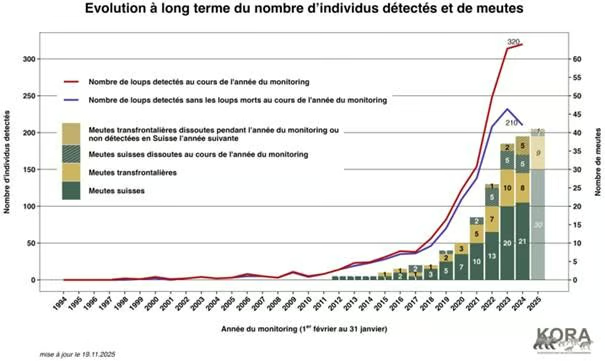
There are therefore other explanations and factors to consider in order to demonstrate any effectiveness of the current culling measures, as well as their scope.
ASSESSMENT OF THE PASTORAL SECTOR'S GOALS
Thirty years after the wolf’s return to Switzerland, numerous motions, requests, and calls for action have followed one another over the years. In fact, more intensive wolf regulation than that provided for in the original Hunting Act has been demanded since the appearance of wolves and packs (the first in Switzerland was identified in 2012 in Calanda, Graubünden). This is evident when examining press releases, position statements, and parliamentary requests.
But in 2026, as policymakers systematically step on the gas pedal of “shoot-to-kill” policies—even though no conclusive study proves their actual effectiveness—the top priority should be to establish the central point of the coexistence framework: what is the real objective of the pastoral sector?
1. Is it to reduce damage/predation? If so, what would then be the “acceptable” threshold for losses, per farm, at the cantonal or federal level? Given that 288 annual losses were already a threshold far exceeded, it is therefore important to know exactly which direction to take. While being transparent and frank: it will be impossible to go below this figure with a minimal number of packs. This question is therefore the anchor point for any future debate and decision...
2. Is the goal rather to limit risks by focusing on more comprehensive herd protection and investing in its study and development? This would also require accepting what we might call the “tolerable threshold”—that is, a certain degree of tolerance regarding the number of annual losses per farm, within reasonable limits. And thus avoid intervening in stable packs that pose little threat to herds.
3. Or are we now seeking to achieve an implicit goal: the total absence of losses or attacks?
This distinction is essential, as it determines the entire logic of future wolf management in Switzerland.
Reducing damage and limiting risks are realistic goals. They involve the implementation of official protective measures, rigorous field monitoring, targeted interventions (based not on political assessments but on the behavior of wolves and nature), and the ongoing adaptation and evaluation of practices. Nevertheless, it will be necessary to engage in reflection but also, and above all, to establish more precise quotas and figures, while accepting the variables of risk and fluctuation inherent in living systems.
On the other hand, aiming for “zero loss” amounts to pursuing a threshold that does not exist in any system of coexistence between human activities and large wildlife. No country in the world, facing the long-term presence of wolves or any large predator, has completely eliminated attacks on livestock! No protection measures, no regulations, and no culling can entirely eliminate the risk. The wolf is now permanently established in Switzerland, and conservation obligations also require the maintenance of a viable population of this protected species.
Consequently, if the political or societal goal implicitly becomes “zero attacks”—as is increasingly evident, even if not explicitly stated—the outcome is inevitable: regulatory measures will never be deemed sufficient:
Quotas will always be considered too low.
Culling will always be too limited.
Interventions will always come too late.
A dynamic of constant pressure then gradually takes hold: since wolves will necessarily remain in the territory, and since no regulation can completely eliminate the risk, much less predation. The demand will structurally become one for “more and more”: more culling, faster, across more territories, with ever-decreasing tolerance for even the slightest residual predation.
This dynamic raises a central question for the future of wolf management: can a public policy remain stable, coherent, and credible when it is based on a completely unachievable goal? An example would be applying the same pressures to stop all forms of crime, once and for all. Complex biological and social systems generally show that no public policy can completely eliminate a phenomenon, but rather limit its scale and consequences. Just as with wolf predation, crime statistics will therefore fluctuate, with decreases and increases over the years, depending on multiple factors.
Thus, at the political level, suggesting or promising—explicitly or implicitly—the possibility of completely eliminating attacks (or the wolf...) amounts to fueling constant frustration. A frustration that undermines both livestock farmers, authorities, protective measures, and, ultimately, the very acceptability of any strategy for sustainable coexistence.
The question is therefore no longer just how many wolves Switzerland can accept. It also becomes: what expectations can Switzerland reasonably promise to meet? Given the constant and intense pressure from both the pastoral and political spheres, one cannot help but note that the intent behind every initiative and decision is no longer aligned with the acceptance of a certain quota of losses or of wolves and packs on Swiss soil in the future.
Several recent statements suggest a growing expectation of virtually zero predation, including occasional predation. It would be wise to recall that during the first three phases of proactive regulation in Switzerland, packs were targeted for preying on between 1 and 5 sheep annually, in protected areas (though where clear gaps in protection had been identified, making improvements possible), some of which had not preyed at all during the current year.
A PROTECTED SPECIES NOW EASIER TO HUNT THAN GAME?
Wolf management, as it is taking shape with the various motions filed (which cannot be implemented without an amendment to the Law on Hunting and the Protection of Wild Mammals and Birds—LChP), would then allow for a rather absurd situation that cannot be ignored by federal and European authorities: the Canis lupus species would be subject to culling measures that are sometimes more extensive than those for certain game species! And this despite the fact that its protected status, although modified in December 2024, remains higher than that of deer, roe deer, and other prey species.
Here are the situations in which hunting will be permitted:
Wolves may be killed even if it has not preyed on livestock, i.e., purely as a preventive measure! In Switzerland, this will allow for the culling of entire packs or two-thirds of the pups without significant damage—as recommended in Article 9(1) of the Bern Convention—having been inflicted on livestock. And in France, it is already permitted to shoot wolves that pass near herds, without any attempt at an attack and, worse still, without official protective measures being mandatory—a step backward of 30 years!
And this is done with no regard whatsoever for the role of the individual within a pack, among other things. Several scientific studies suggest that non-targeted culling or culling of breeding individuals can contribute to social destabilization within packs, particularly when those packs are stable. This strategy raises several questions about its medium- to long-term consequences, including an increase in attacks or forms of mistreatment, such as the case of wolf pups left without parents or forced to disperse without proper guidance. This creates fertile ground for wolves to exhibit increasingly problematic behavior in the future...
Wolves may be hunted year-round, including during the breeding season, whelping, and the rearing of pups. It should be noted that in Switzerland, NO huntable species may be killed during the spring—that is, during these extremely sensitive phases! The wolf would thus be the sole exception, which raises very serious questions regarding ethics and biology, particularly concerning the survival of young wolves still dependent on adults. Laws do, however, govern animal welfare, ensuring the protection of wildlife during highly sensitive periods, among other things.
Wolves may be hunted throughout Swiss territory, including in reserves, hunting-free zones, and even regional nature parks!
You get the picture: although wolves are on the list of protected species—which require more careful monitoring to prevent sudden population declines or genetic issues caused by various human pressures (poaching, hunting, road traffic) or climate-related factors (loss of natural habitats, etc.), the wolf could, in certain situations, face hunting pressure far more extensive than that faced by some species officially classified as game! And this despite the fact that, even though the effects of culling remain insufficiently assessed, they will never allow us to achieve a goal such as zero loss, neither now nor in the future. We echo the words of an opponent, just a few days ago, in a comment posted following a predation incident: “One wolf is already one too many”!
Wolf management should not be approached through the lens of unattainable goals or under the influence of primarily political or emotional dynamics, but rather within the framework of a comprehensive approach that integrates all factors related to the coexistence of human activities and large wildlife. Such an issue requires a vision that is at once scientific, pragmatic, and bilateral, taking into account both the realities of the pastoral world and the ecological functioning of the wolf and the ecosystems in which it lives. From this perspective, it becomes essential to initiate a fundamental reflection on a central yet rarely explicitly addressed concept: that of the “tolerable threshold.”
We also hope that the Bern Convention, which has remained conspicuously silent since the wolf’s declassification despite numerous breaches of the “agreement” by certain signatories, will recognize the scale of the current abuses, both in Switzerland and in France. It is becoming difficult to deny these abuses, given that a species with protected status is on the verge of becoming easier to hunt than any other huntable prey species... And that poaching, which is rampant and unfortunately impossible to quantify, will undoubtedly have a significant impact on the wolf population, both in terms of numbers and genetic health.
Wolf management will likely not be sustainable if it continues to be approached from an essentially one-sided perspective. An issue involving human activities, biodiversity, ecosystem dynamics, and social acceptability requires, by definition, a multidimensional approach based on scientific assessment, transparency regarding the objectives pursued, and recognition of the inherent limitations of any wildlife management policy.
Article : Team Wolf Mission
Photo : Wolf Mission
Sources : KORA / Federal Office of the Environment (FOEN)
pression politique étude objectifs inatteignables attentes espoir prédation chasse gestion régulation meutes loup no more zero attack pressure insatisfaction hopes management regulation shooting project study wildlife pack nature wolf
Related posts

From Monitoring to Expertise—Understand Before Regulating