

Poaching: Alarming Figures Since the Introduction of Proactive Regulation
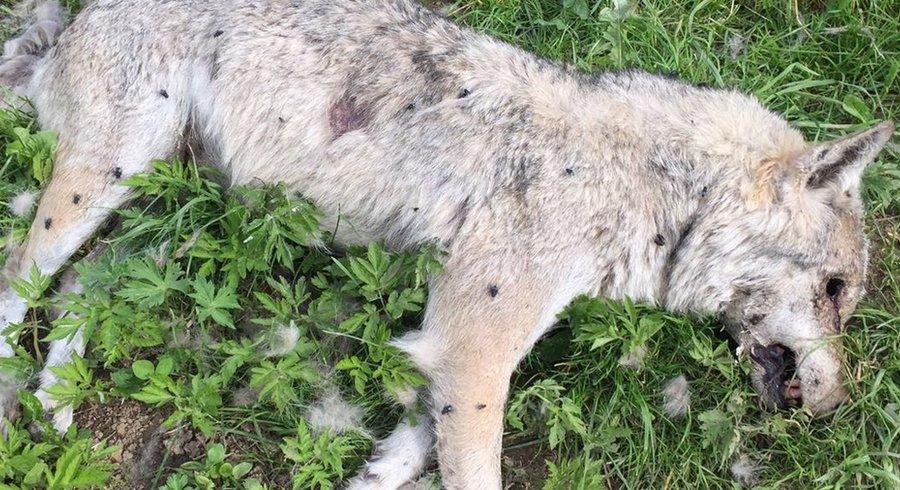
Effective December 1, 2023, new federal regulations authorize proactive wolf management, specifically allowing interventions targeting certain packs even before new damage occurs, subject to legal conditions.
To examine a possible trend in illegal killings, Mission Loup analyzed official mortality data published by the KORA Foundation for the cantons of Valais and Graubünden.
Two strictly identical periods of 959 days were compared:
1. Before proactive management: April 16, 2021, to November 30, 2023.
2. After its introduction: December 1, 2023, to July 16, 2026.
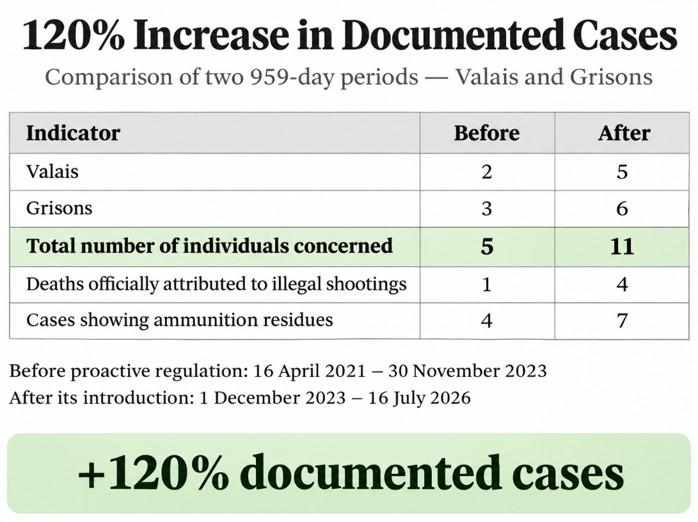
The number of individuals affected thus rose from 5 to 11, representing a 120% increase.
This comparison combines two distinct indicators: deaths officially attributed to illegal shootings and carcasses showing traces of ammunition. Each animal is counted only once in the total.
The findings are concerning. However, they do not prove that proactive culling is responsible for this increase. To accurately assess the actual trend in poaching risk, one would also need to consider the growth of the wolf population, differences in monitoring, and the likelihood of carcasses being discovered.
A TREND TO BE CONSIDERED IN THE DEMOGRAPHIC CONTEXT
The Swiss wolf population has grown significantly in recent years, rising from an estimated 150 individuals at the end of 2021 to 350 individuals detected in 2025/2026. This growth was particularly pronounced prior to the introduction of proactive management in December 2023.
The cantons of Valais and Graubünden were already among those with the largest wolf populations. This reality must be taken into account when interpreting the results.
The 120% increase in documented cases therefore does not necessarily indicate a corresponding rise in the risk of poaching, as a larger population may also lead to more recorded cases.
However, this trend raises legitimate questions and warrants an analysis that takes into account cantonal population sizes, differences in detection rates, and undocumented illegal mortality.
POACHING: THREE VERY DIFFERENT REALITIES
It is important to examine poaching in these three forms:
1. Wolves Confirmed to Have Been Illegally Killed
These are animals found dead where investigations confirm that their deaths resulted from an illegal act. These cases are recorded in official mortality statistics when they are identified and reported to the agencies responsible for monitoring.
In the two cantons studied, their number rose from 1 to 4 between the periods compared. However, these figures do not necessarily represent all animals that were victims of poaching.
2. Wolves with ammunition residues
This second category is particularly interesting because it reveals events that may have gone unnoticed while the animals were alive. Some wolves found dead following a traffic collision, or legally hunted, show traces of ammunition during postmortem examinations. When these traces correspond to injuries sustained prior to and distinct from the cause of death, they indicate that the animal had previously been shot and survived.
How many wolves have thus been wounded by gunfire without anyone ever having known about it?
The presence of residue is an important piece of physical evidence, but it does not always allow for determining the date, location, or circumstances of the shooting. Whether the shooting was illegal cannot be established without further investigation, particularly forensic analysis.
Another point is crucial: the canton in which a wolf is found dead does not necessarily correspond to the one where it was previously shot. Wolves, particularly young ones dispersing from their home range, can travel several hundred kilometers.
The statistics presented here are therefore based on the canton and the date of the recorded death, not on the location or date of any prior shooting.
3. Wolves That Disappear Without a Trace
Finally, there is a third reality, by far the most difficult to quantify: that of animals whose remains are never found.
A wolf that is the victim of an illegal shooting, poisoning, or another method of killing may die in a particularly remote or hard-to-reach area. Some carcasses may also be deliberately concealed.
These situations are not captured in official statistics when neither the body nor other usable evidence is discovered. Added to this are injured animals that survive without ever being examined.
The absence of a discovered carcass does not, therefore, mean there is no poaching. Conversely, the unexplained disappearance of a wolf does not, in and of itself, constitute proof of an illegal act. This is the crux of the difficulty with this reality, which we might describe as unquantifiable: the number of documented cases does not allow us to determine the true extent of the phenomenon.
GENETIC TRACKING: TRAJECTORIES THAT SHED LIGHT, WITHOUT REVEALING EVERYTHING
To deepen this analysis, Mission Loup examined the available genetic records for the eleven wolves found to have ammunition residues in Valais and Graubünden during the periods studied.
Among the ten genetically identified individuals, only two have, in the records consulted, documented sightings across multiple cantons:
F154: From Valais to Graubünden
This young female wolf was genetically identified for the first time within the territory of the Hérens-Mandelon pack on February 5, 2023 (subadult born in 2022). Her presence there was still documented in September of the same year.
On January 8, 2024, she was legally killed (proactive culling) in Graubünden, within the territory of the Beverin pack. Traces of ammunition were also found on her carcass.
M304: From Ticino to Graubünden
This male was first identified in Ticino on November 6, 2022, and then in Graubünden on January 10, 2024. He was ultimately legally culled in Graubünden on September 19, 2025. His carcass also showed traces of ammunition residue.
These two journeys illustrate the limitations of interpreting the results geographically. For the eight other identified individuals, the genetic data consulted document their presence only in the canton where their death was recorded. However, this by no means implies that they never visited other cantons.
Many young wolves leave their natal pack without having been genetically identified. Their first DNA sample may be collected well after they have begun dispersing, sometimes very far from their birthplace. Genetic identifications therefore provide evidence of presence at specific times and locations, but do not allow for the reconstruction of an animal’s entire movement history.
Consequently, none of these records, on its own, allows us to locate or date the shootings responsible for the ammunition residues.
TRANSPARENCY OF GENETIC DATA: A MISSING LINK IN SWISS MONITORING
Genetic monitoring is an essential tool for understanding the structure of wolf populations, their movements, and how packs function.
In Switzerland, the KORA Foundation makes some of its monitoring data available to the public, including individual genetic identifications. However, kinship relationships between individuals are not accessible in the public data. Nor are they by any means fully included in reports on proactive culling, which simply state whether or not the individuals belonged to the targeted packs. Furthermore, no additional details are provided for those whose birth pack was not the one targeted but whose identity is known to KORA.
Yet this information is essential for determining an animal’s family origin, identifying breeding individuals, tracking dispersal, and understanding pack dynamics. Limited access to this data hinders independent verification of certain analyses by researchers, field-based organizations, and interested citizens.
The question remains: how can one fully assess the consequences of culling on a pack’s family structure without being able to consult the kinship links established between individuals?
This question takes on particular importance in the context of proactive management, where identifying breeding individuals and their offspring can help assess the biological consequences of culling—particularly with regard to wolves killed that belong to neighboring packs.
The Aarhus Convention recognizes the principle of access to environmental information, subject to applicable legal restrictions. However, this principle does not imply an obligation to spontaneously publish all genetic data. Mission Loup nevertheless believes that greater accessibility to established kinship relationships—without disclosing sensitive information that could compromise animal welfare—would enhance scientific transparency and understanding of management decisions. It is therefore disappointing that this data is not included in the results of the proactive monitoring program provided to associations upon request.
Knowing a wolf’s genetic identity is one thing. Understanding its place within a family and a population is another.
A PHENOMENON ALREADY EXAMINED BY AMERICAN RESEARCH
The trends observed in Switzerland warrant comparison with several scientific studies conducted in the United States. In 2016, Guillaume Chapron and Adrian Treves published a study titled Blood does not buy goodwill: allowing culling increases poaching of a large carnivore, focusing on wolves in Wisconsin and Michigan.
Their analyses suggested that relaxing policies allowing legal hunting could be accompanied by an increase in poaching, contrary to the hypothesis that such authorizations would necessarily foster greater acceptance of predators. In 2020, another study of wolves fitted with tracking collars in Wisconsin revealed a link between the relaxation of culling policies and an increase in the disappearances of tracked individuals.
In particular, the authors considered the possibility of undetected poaching as a partial explanation for these disappearances. Although this research has sparked debate and methodological criticism, it demonstrates that this relationship warrants further study and cannot be dismissed without careful examination.
In Switzerland, the available data remain insufficient to determine whether the increase observed since December 2023 is due to the effects of population control policies, growth in the wolf population, or a combination of factors. It will therefore be essential to investigate this crucial issue further through an independent study.
A TREND THAT WARRANTS IN-DEPTH ANALYSIS
Over two identical periods of 959 days, the mortality data available for Valais and Graubünden show a 120% increase in the number of wolves officially recorded as victims of illegal shooting or found with ammunition residues.
These results do not prove a corresponding increase in the actual risk of poaching, but they do raise legitimate questions.
To better understand this trend, several pieces of information would be necessary: detailed conclusions from forensic examinations, information regarding old projectiles, genetic profiling, dispersal data, population trends, and unexplained disappearances.
This is by no means an attempt to accuse the authorities or specific individuals, much less to draw conclusions beyond what the evidence supports. The aim is to call for a documented trend to be examined with the scientific rigor it deserves. For behind the numbers lie animals whose injuries were sometimes not discovered until after their death. And others whose fate will certainly remain unknown forever, given the differences in genetic identification methods across European countries.
A CUMULATIVE MORTALITY RATE WHOSE EXTENT REMAINS UNKNOWN
Beyond the question of a possible link between legal culling and poaching, another issue deserves special attention: the accumulation of various causes of mortality within wolf populations. In addition to culls authorized by the authorities, there are natural deaths, accidents, as well as documented acts of poaching and those that go undetected.
While legal culls are, in principle, recorded, illegal mortality remains largely unknown. Yet these losses can accumulate and affect population size as well as population dynamics, particularly when breeding individuals are involved. A population whose recorded numbers remain stable or are increasing is not necessarily immune to local disturbances, particularly when mortality affects the family structure of packs.
The assessment of a population’s status should therefore not rely solely on estimated numbers or the number of individuals legally harvested. It should also take into account the various sources of mortality, the uncertainties inherent in monitoring, and the potentially undetected portion of illegal killings.
The latter cannot be reliably quantified based solely on recovered carcasses. Ignoring this “invisible” mortality would risk underestimating the actual losses suffered by the wolf population. In a context of intensive culling, this uncertainty should serve as a cautionary factor when assessing the biological consequences of culling.
CONCLUSION
Legal culling is measured by the number of animals killed. Poaching, however, remains a hidden issue that mortality statistics cannot fully reveal. But the question therefore remains open: Does the intensification of legal wolf culling in Switzerland go hand in hand with an increase in illegal killings of this species?
This is a question to which only an independent and in-depth analysis can provide answers. We hope, therefore, that such an analysis will be conducted and taken into account in any document or study assessing the status of the Swiss wolf population.
Article : Team Wolf Mission
Photos : Illustration & F05, female wolf poisoned in Fribourg (Jaun – June 2017)